Contact us 01889 597 283 | contact@oaktimberstructures.co.uk


Contact us 01889 597 283 | contact@oaktimberstructures.co.uk
Oak Timber Structures has called Norbury Park Estate home since November 2025. In west Staffordshire, the heart of mainland Britain, our location allows us to distribute those oak structures throughout the UK.
Beyond its prime location, the estate aligns with one of our core beliefs: sustainability. Here's the story of the magical 884-hectare Norbury Park Estate and why it’s the perfect match for our operations.
It’s safe to say we aren’t the first to settle on the estate; evidence points to a rich history with Celtic and Roman habitation. The Medieval Domesday Book even mentioned Norbury Village in 1086.
The site has quite a history, and there’s an elaborate manor house written in the estate's story. When the estate came under the ownership of Sir Ralph le Botiller, a descendant of a Norman knight, he ordered the building of a grand manor between 1290 and 1307.
By 1521, the Skrymsher family purchased the manor and its lands, which remained in the family for 254 years, including Sir Charles Skrymsher who became the High Sheriff of Staffordshire. It was the Skrymsher family that built the Norbury Park Farm House and the Grade II listed building remains on site today.
Norbury Park Estate would eventually be purchased by the wealthy Admiral George Anson and inherited by Thomas Anson, who was created Earl of Lichfield by William IV. Through the Lichfield lineage, famed photographer Patrick Lichfield inherited the estate. He was a notable owner and confidant of the royal family; famous for photographing the wedding of Prince Charles and Lady Diana. Princess Anne and Princess Margaret also visited Norbury Park during his ownership.
His son decided to relinquish the estate, and it was broken up into smaller sections, with some land sold to local farmers. While the original manor house was demolished by 1838, the land alone became the ideal spot for a carbon offset project, which is where the modern-day story begins.
The current owner purchased an original 400 hectares in 2009, with further hectares added in 2021 and 2023. Norbury Park’s vast rural landscape is now a beacon in the fight against climate change, and we're proud to say, is where you’ll find our head office.
The carbon offset project is a mission that we both admire and support at Oak Timber Structures. After all, we can never forget that timber is not only the backbone of our products, but woodland is vital for our very existence now and for generations to come.
On average, each person in the UK is responsible for over 5 tonnes of carbon dioxide a year, with another 8 tonnes from imported goods. So, one of the key goals of the Norbury Park owners became to store as much carbon dioxide as possible to help offset their carbon footprint.
Since taking ownership of the land, the tireless commitment to the environment has yielded fantastic results. By 2025, carbon sequestration, or simply the capturing of carbon from the atmosphere and storing it, reached 8,000 tonnes per year. A staggering number that goes well beyond the average person's carbon footprint.
How have they achieved such incredible results? This is largely thanks to the effective and strategic growth of woodland. Trees in a healthy ecosystem absorb more CO2 from the atmosphere, helping tackle climate change. Although it might seem straightforward, there’s actually more to such a feat than you think.
Although the Norbury Park Estate has existing woodland, there was also poorer quality arable land. It's on the more neglected land that a large reforestation programme began. Since 2009, the owners have grown an impressive 400 acres of new woodland containing over half a million (500,000) trees.
There's been a revolutionary approach to the new woodland with different species of trees planted close together. Results show new trees thrive under a diverse forestry approach, with each species having a unique ‘role’ and helping one another.
Put simply, unique species aren’t competing as different trees have different growth patterns and requirements. For example, some have deep roots, while some have shallow roots. Likewise, some species need lots of sunlight, others are happier in the shade.
From Alder to Yew, the highly diverse approach to planting has grown 100 different tree species, some of which aren’t even native to the UK. Although the British native trees play their role, alongside species from more temperate climates, the complex mixture has improved the overall robustness of Norbury Park's young woodland.
To enable trees to thrive, halo pollarding is used to grow younger trees into maturity. The more common technique is halo thinning, which selects ‘winning’ trees and removes the surrounding competition. However, halo pollarding trims the surrounding trees, keeping them alive, which exposes the canopies of ‘winning’ trees to promote growth.
Complex woodland alongside the halo pollarding has seen dramatically improved growth rates when compared to monoculture woodland.
As you can imagine, such a huge landscape already had existing woodland comprising large oak, beech and larch trees. That hasn’t gone unnoticed either. Not only are they conducting their own research, but there are also collaborations on an international scale.
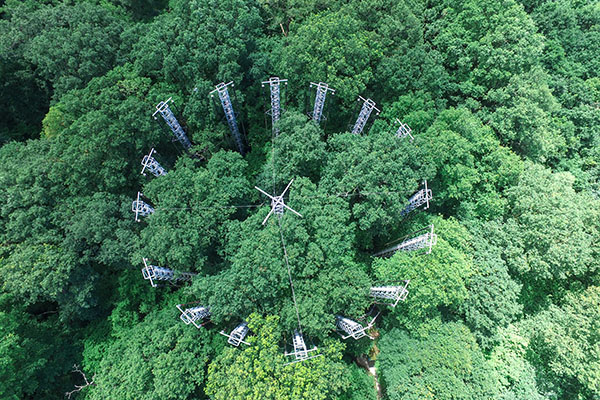
The once neglected woodland is now used for the FACE (Free Air Carbon Dioxide Enrichment) project. 10 hectares of the Norbury Park woodland, including English oak trees, are leased by the University of Birmingham for this purpose. It’s one of only three facilities worldwide and the only one in the Northern Hemisphere.
The University of Birmingham's BIFoR, short for the Birmingham Institute of Forest Research, is leading the experiment, which monitors how the ecosystem and woodland will respond to the growing carbon levels. With mature oak trees incubated in an environment similar to the projected CO2 levels of 2045, the scientists are monitoring and learning from the land.
As Norbury Park owner Professor Jo Bradwell states in the book ‘Norbury Park: Tackling Climate Change’, "It is well known that high levels of CO2 increase plant growth... However, experiments in the open air are less common, particularly around large trees in a natural setting. While it is widely accepted that trees grow faster in a higher CO2 environment, the fear is that this might only be in the short term. If tree damaging aphids, for example, eat more leaves as a result of faster tree growth, or diseases become widespread, there might be no increase in carbon sequestration."
Dr Kris Hart, operations manager of the experiment, said, "This piece of Staffordshire countryside may yield extraordinary information that could transform global understanding of climate and environmental change on our trees and wildlife."
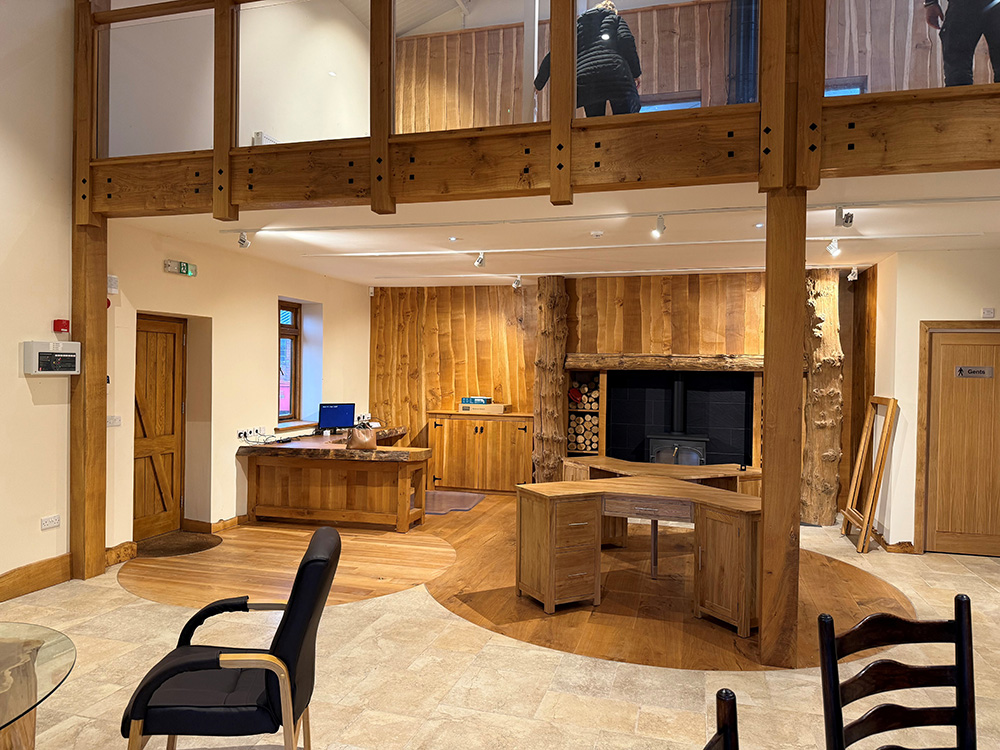
From the descendants of knights and royal visits, to Norbury Park pioneering the way of tackling climate change, it’s an incredible story. Now, Norbury Park Estate is part of the Oak Timber Structures story too. With our relocation complete, we’re beginning to enjoy the benefits of a workplace in nature on a site tackling the threat of climate change.
So what does our move to the Norbury Park Estate mean for Oak Timber Structures customers? Besides our address… nothing! You can expect the same friendly service, reliable skilled craftsmanship, and identical transparent pricing through our Online Designers. All this knowing that we continue to source all oak from renewable forests and that our new location is pushing for a carbon neutral future. We're delighted to be here and excited for a long and successful relationship with Norbury Park.
Head Office
Oak Timber Structures Ltd
New Barn, Knightley Park Farm
Lodge Lane,
Woodseaves,
Staffordshire,
ST20 0NZ
Deliveries and Collections
Please call in advance to book in.
Oak Timber Structures Ltd
Campions
Norbury Junction
Stafford
Staffordshire
ST20 0PN
Information in this article is taken from ‘Norbury Park: An Estate Tackling Climate Change’ by Jo Bradwell. (ISBN 978-1-0369-0095-3)